
Field Update · Recognition
Ahtna-Target JV Shortlisted for a 2026 World Demolition Award
The NASA Marshall Space Flight Center test stand implosions are shortlisted in the Explosive Demolition category of the 2026 World Demolition Awards.

Some projects ask more of a team than anyone planned for. For the Ahtna-Target JV, that project was the demolition of Facilities 4550 and 4572 at NASA’s Marshall Space Flight Center, and it has earned a place on the shortlist for the Explosive Demolition Award at the 2026 World Demolition Awards.
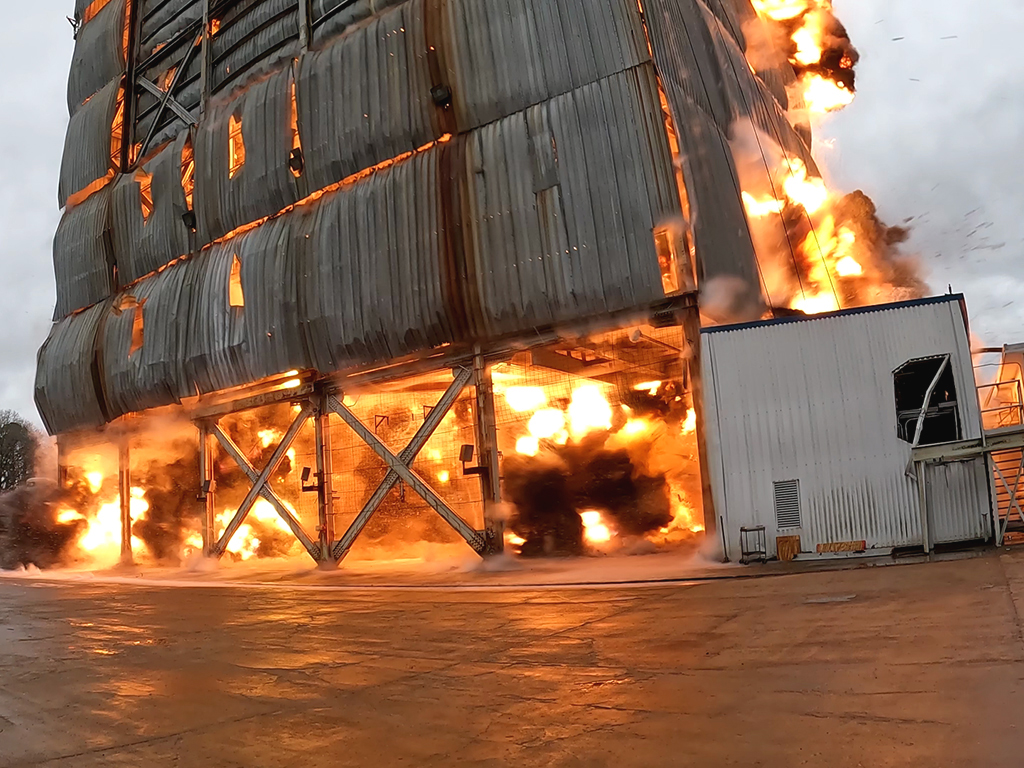
The Saturn V Dynamic Test Stand and the Saturn I Static Test Stand came down in two independently designed implosions, carried out together inside an active aerospace facility. Both structures fell within their designed footprints, with no damage to adjacent NASA infrastructure and no reported safety incidents over almost 30,000 worker hours. More than 90 percent of the material was recycled.
Two towers, two puzzles
On paper, the two stands could hardly be more different. The Saturn V Dynamic Test Stand rose 363 feet, roughly 410 with its crane, on a footprint of just 98 by 98 feet. It was built to suspend an entire Saturn V rocket inside its frame and shake it with the vibration loads of spaceflight. The Saturn I Static Test Stand stood 200 feet tall, a steel-framed firing stand built to hold live Saturn I and Saturn IB boosters in place under full thrust.
Both were designed to resist enormous forces, which is exactly what makes them hard to bring down. Each needed its own structural analysis, its own blast sequence, and its own charge design, all synchronized so that neither collapse could affect the other, or anything standing nearby.
The team behind it
No single company could have done it alone. The Ahtna-Target JV brought together Target Contractors and Ahtna. Paul Rose, a licensed structural engineer, led the implosion design and produced a separate analysis and blast sequence for each tower. Ron Gilbert and his team at Dykon Demolition and DetX designed and carried out the explosives work. Marty Molyneux served as Program Manager, JJ Martin shared on-site leadership, and Alex Snyder, as Site Safety and Health Officer, ran safety across multiple concurrent worksites. NASA Marshall’s Megan Vansant and Justin Taylor were partners throughout.
Months of preparation, seconds of impact
Behind the seconds it took the towers to fall were months of preparation: structural surveys, drone photogrammetry, blast modeling, permitting, pre-blast surveys, seismic analysis, and coordination with every stakeholder.
At 9:46 AM on January 10, 2026, both towers came down within seconds of each other. Twelve seismographs monitored each event, and the peak ground vibration was 0.1497 inches per second, about one-fifth of the U.S. Bureau of Mines threshold for minor damage. An independent analysis by Sauls Seismic found no evidence that either implosion damaged nearby privately owned structures or critical infrastructure.
What the judges look at
The World Demolition Awards are judged by an international panel with more than 300 years of combined industry experience. Entries are assessed on overall professionalism, level of expertise, how the main project challenge was overcome, financial and schedule management, safety record, team management, and client satisfaction. We are proud of how this team measured up.
Update: after Madrid
The awards were presented at World Demolition Summit 2026 in Madrid. We didn’t take home the Explosive Demolition Award. PDC Explosives Engineering did, for the Naga Thermal Smokestack Demolition, and we congratulate them. Being shortlisted for this project is an honor, and we are proud of the team that planned and carried out this work with NASA.


